



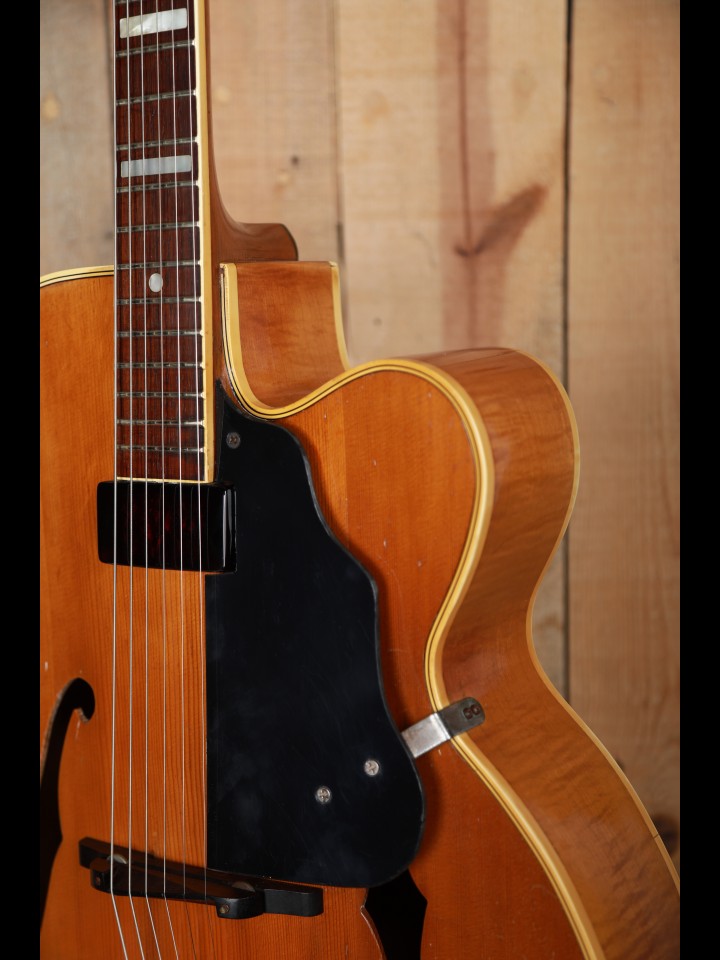
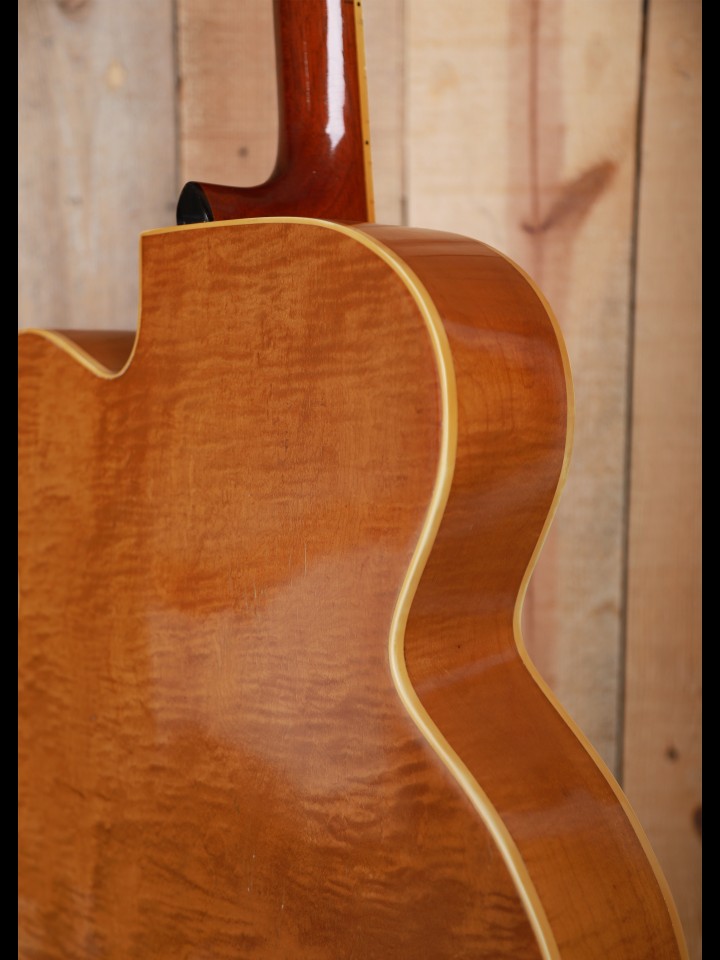

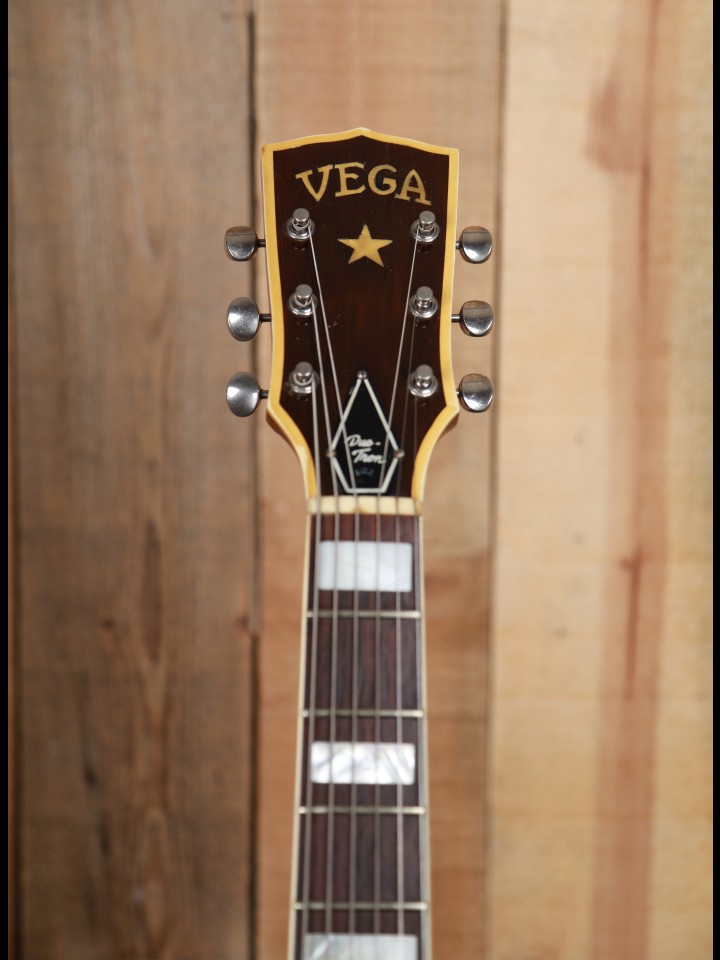


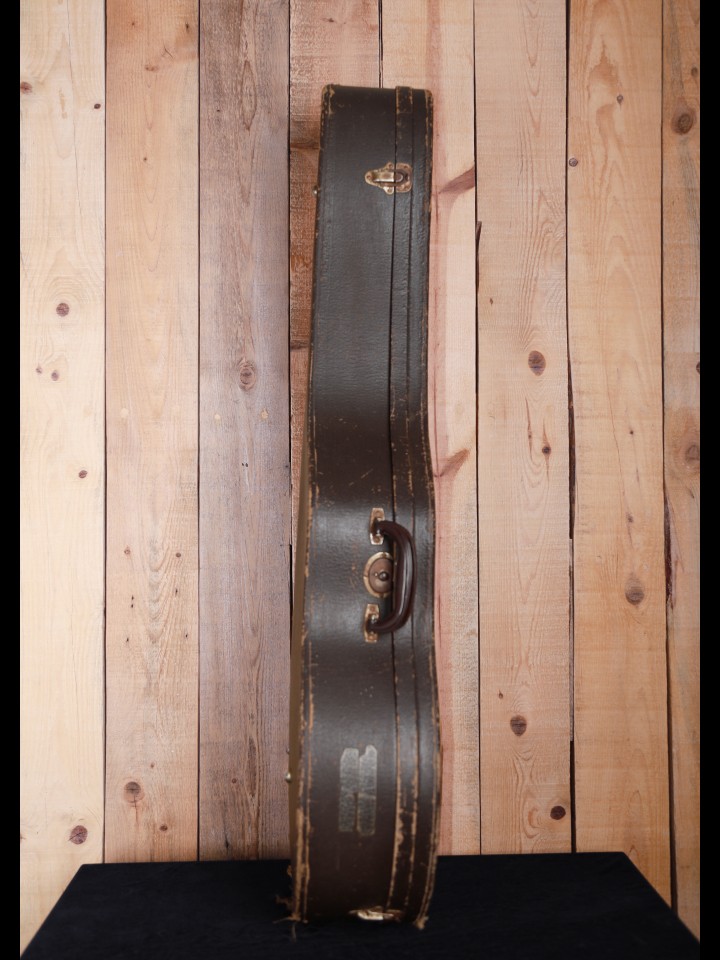
c. 1950 C-166 Cutaway with Duo-Tron Pickup
The Vega brand has long been primarily associated with banjos, as much of the Vega company history is dominated by the production of banjos. This reputation really took hold when Vega acquired A.C. Fairbanks, another Boston-based manufacturer with a strong focus on banjos, in 1904 (the purchase price was purportedly the handsome sum of $925 plus $1 for four patents). In the years that followed, Vega made watershed contributions in banjo design, such as the Tu-ba-Phone tone ring in 1909. They also created noteworthy models that were born out of collaborations with significant artists (e.g., the Vegavox made for Eddie Peabody, and the long-neck 5-strings seen in the hand of Pete Seeger). Yet, even from its very origins in 1881, Vega had its hands in guitar production, as the founders, Julius and Carl Nelson, had evidently made guitars while employed at the John C. Haynes Company—they ultimately purchased the John C. Haynes Company and transformed it into Vega. Along that line, on the heels of the A.C. Fairbanks deal, Vega also purchased the plectrum division of Thompson and Odell, thus enhancing their production capacity for guitars, mandolins, and, yes, even more banjos. As the company continued to grow in the first half of the 20th century, they branched out into brass instruments, Hawaiian lap steels, and acoustic and electric archtop guitars (beginning around 1930), making Vega quite diversified for just a “banjo company.” Yet, the luminous Vega star eventually began to fall in the 1950s as sales declined. This eventially lead to the sale of the company to Martin in 1970, who did little with the brand to speak of before selling it to its present owner, Deering Banjos, in 1989.
Given Vega’s banjo-heavy reputation and the fairly limited timeframe during which they produced archtop guitars, it is certainly understandable that the Vega brand might not immediately register with many archtop players today. Even so, as evidenced by this c. 1950 C-166 Duo-Tron, Vega manifestly had a good touch and a tasteful aesthetic sense when it came to making a quality jazz box. Judging from the quality of its construction, this C-166 would have been competitive with many top-tier archtop models produced at the time—perhaps this would explain extant photo evidence of the great Charlie Christian electing to play a Vega archtop through what appears to be a Vega amp! With a solid, carved spruce top and a 17” wide body, this C-166 is a powerful, responsive, and resonant acoustic instrument. The make of the pickup of the pickup in this guitar is unclear (by all indications, it might have been made in-house), but we are impressed by its overall lush and detailed character. The Duo-Tron control system that is mounted to the top of the tailpiece is perhaps the most eye-catching element of this instrument—the pair of very hip, cream “chicken head” knobs really completes the package. Housed in a reddish-MOTS (Mother of Toilet Seat)-tortoiseshell-ish cover, the electronics for the volume and tone control are fairly accessible by simply removing the tailpiece. Needless to say, the Duo-Tron controls, complete with the screw-in amphenol connection, indicate that this C-166 originated during the dawn of the electric guitar. On a related note, it is worth noting that this system requires a screw-in amphenol cable, common in the era (a repaired and fully-functional vintage amphenol cable is included with the guitar, but the next owner would be well-advised to source a backup!. The nut width of this guitar is perhaps the only questionable feature, being admittedly narrow at 1 5/8”. Even so, this C-166 is evocative and inviting enough that one is inclined to overlook such things in favor of exploring all the great tone that this guitar has to offer. All in all, for collectors and players alike, this Vega is a great value for such an usual and inspiring instrument, as well as a bona fide piece of electric guitar history.
Condition
For its age, this Vega is an excellent overall condition. That said, it was part of an estate of roughly forty, musty, dusty, crusty old guitars that we purchased in the fall of 2025. The collection had been stored in less-than-ideal moist environs for an indeterminate amount of time. As a result, all of the guitars and their respective cases required extensive cleaning, including some mold/mildew remediation to be put in a suitable state for sale. That said, after the removal of years of accumulated grime, we were pleased to find that this guitar had only fairly light cosmetic wear. While the body certainly sports various dings, scuffs, scrapes, and finish checking, we would characterize this wear as age-appropriate “vintage patina” rather than unfortunate abuse. The only structural issue of note is a tight repaired top crack that extends from the top of the treble-side F-hole, underneath the pickguard, and up to the middle of upper bout. Otherwise, the binding is in excellent condition, though we do note one separation seam on the back binding at the treble-side lower bout—the curiously clean appearance of this seam is such that almost appears to be a misplaced joint from the factory, rather than a crack. Meanwhile, all electronics are functioning properly—again, please note that an amphenol cable with a screw-in plug is necessary!
In terms of playability, this C-166 is set up to spec. Prior to embarking on our setup work, we noted some light fret wear that was subsequently lightly sanded, buffed, and polished, but a full fret leveling was not deemed necessary. Otherwise, the original frets have minimal wear and healthy remaining mass at .032”. On a final note, the pickguard and the tuning machines are not original. The existing black pickguard is single-ply and somewhat crudely-cut. The tuners have been changed replaced with matching Kluson Deluxe 3x3—the originals are present and mostly functional, but the gears in two of them were slipping such that strings were inclined to lose tension. EXCELLENT Condition
- 17” Arched Top Hollowbody
- Single Venetian Cutaway
- Solid Carved Spruce Top
- Flamed Maple Back and Sides
- Creme Binding
- 3-Ply Black/White Top Purfling
- Two Unbound F-Holes
- Gloss Lacquer Body Finish
- Mahogany Neck
- C- Shape Neck Carve
- Rosewood Fingerboard
- Mother of Pearl Block Fingerboard Inlays
- Creme Fingerboard and Headstock Binding
- 20 Frets
- Rosewood Headstock Veneer with Inlaid Vega Logo and Star
- Gloss Lacquer Neck Finish
- Single Neck Position Pickup with Plastic Cover
- Floating Rosewood Bridge
- Floating Chrome Tailpiece with Top-Mounted Duo-Tron Volume and Tone Controls
- Nickel Kluson Deluxe 3x3 Tuners with Oval Buttons
- Non-Original Black Floating Pickguard
- Bone Nut
- 1 5/8 Nut Width
- 24.96” (634mm) Scale Length
- .875” Neck Depth at 1st Fret
- 1.03” Neck Depth at 12th Fret
- 9 ½” Fingerboard Radius
- 20 1/16” Body Length
- 17” Lower Bout Width
- 3 1/2” Body Depth
- Original Hard Case
| Brand | VEGA |
| Model | C-166 DUO-TRON |
| Serial Number(s) | 5285 |