

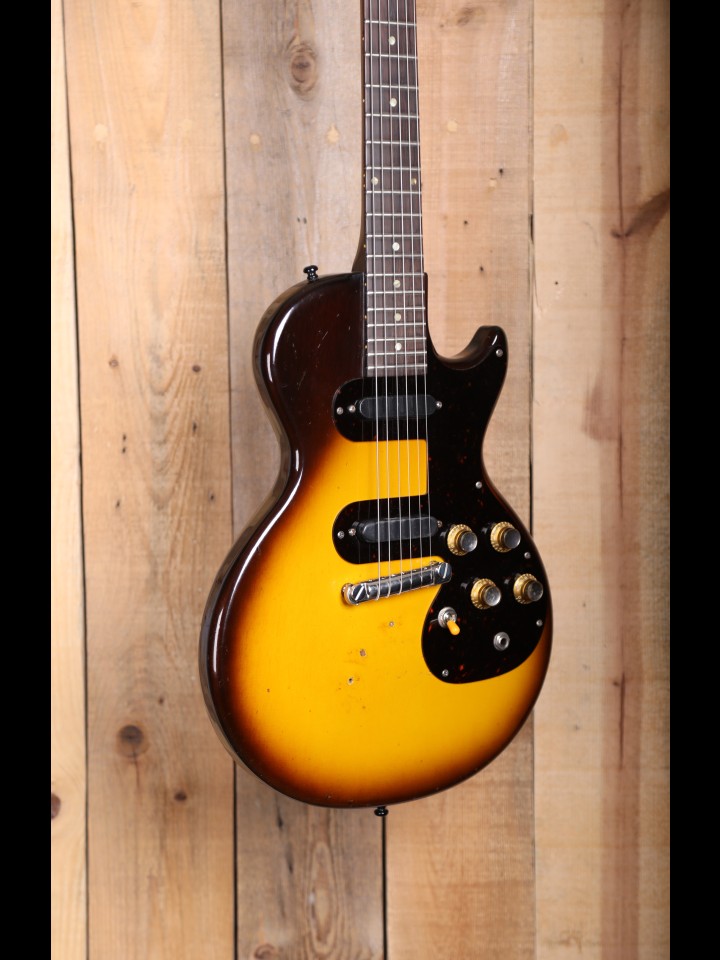
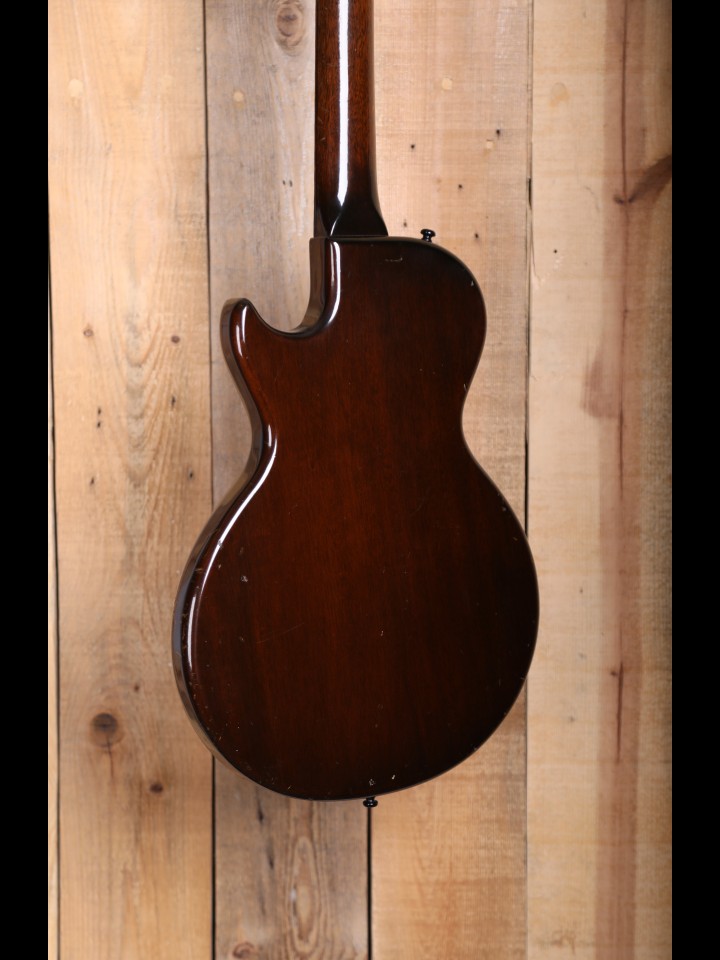
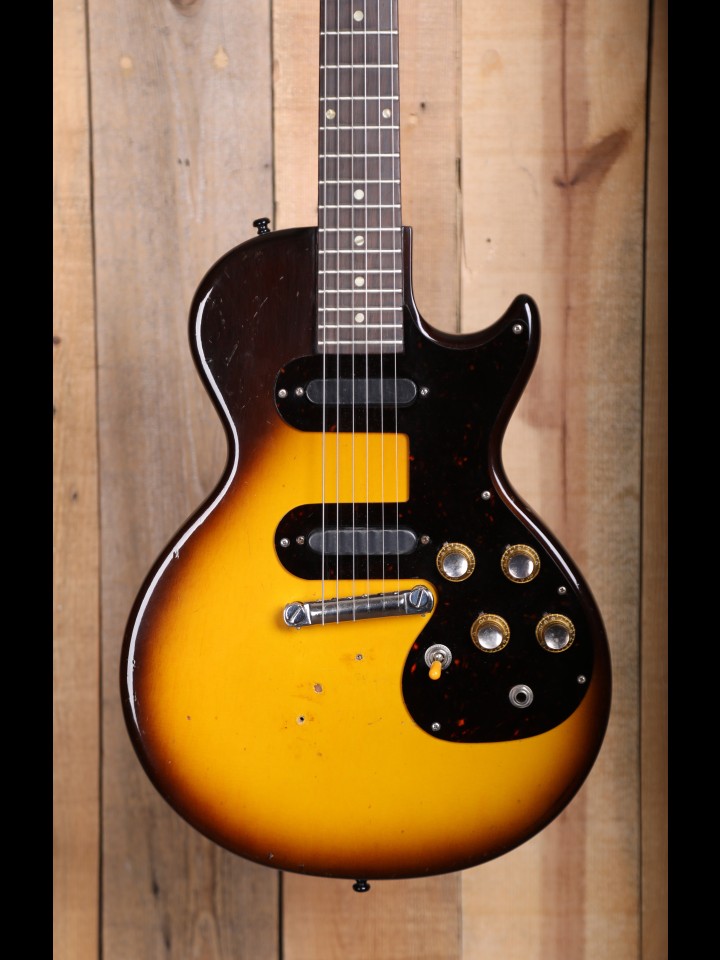
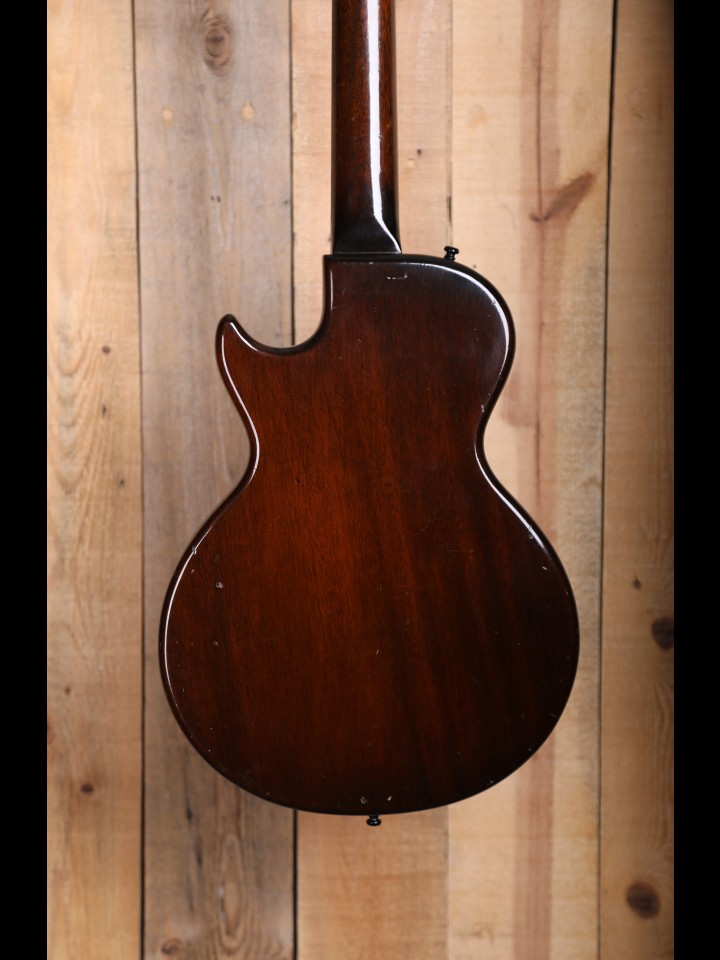
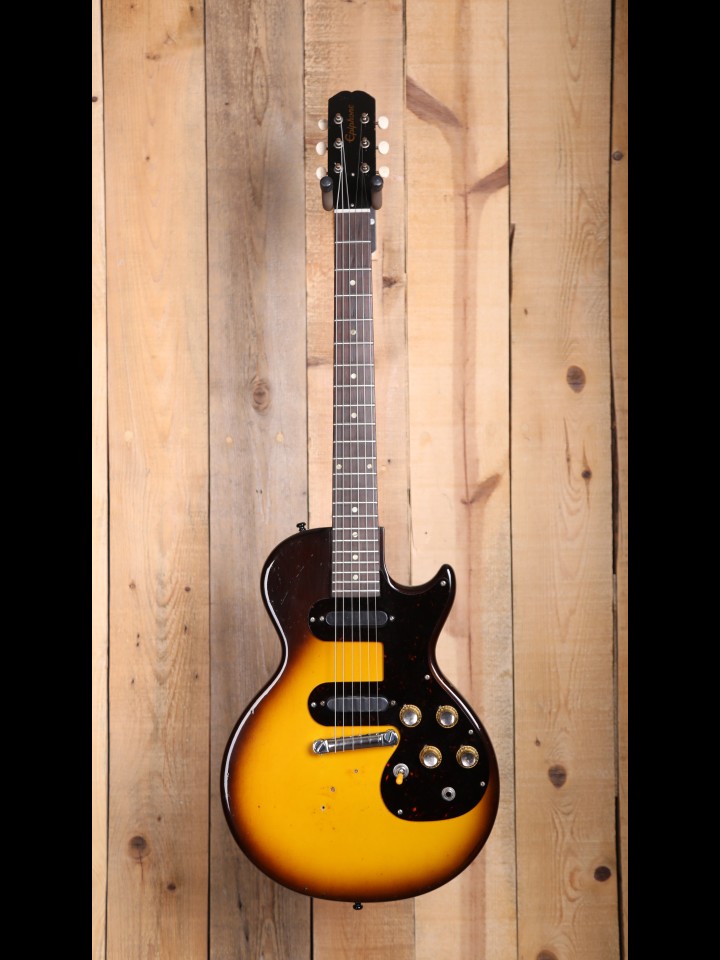
1961 Olympic Single Cutaway (SB722D)
Perhaps one of the most significant (but often overlooked!) developments in the history of Gibson guitars was the acquisition of their competitor, Epiphone, in 1957 for the meager sum of $20,000. While the Epiphone brand eventually morphed into a budget-friendly, overseas–made alternative in the modern era (i.e., post 1985), the line was initially comprised of rebranded models, made right beside their Gibson counterparts in Kalamazoo, MI. Thus, while the Epiphone line was distinguished by slight design modifications (e.g., headstock shape, pickguard appearance), differing model names, or, in some rare instances, unique models (e.g., the Coronet, Wilshire, etc.), most Epiphones were merely Gibsons by a different name. Much like the practices of General Motors, who uses the same chassis and general design for various re-branded car models, this enabled Gibson to have a greater presence in a given market. For instance, if one dealer in a certain town carried Gibson, another in the same town could carry Epiphone without technically violating each other’s territory.
With that in mind, it was no surprise that the Epiphone Olympic was released only one year after Gibson introduced the Melody Maker. Yet, as Gibson was far more invested in producing their primary brand, it was often the case that far fewer Epiphones were produced, making them much more rare. Indeed, that is the case here. Excluding the very rare 1959 Melody Maker D (single cutaway body with two/double wide-format pickups), Gibson produced approximately 2,692 Melody Maker D models between 1960 and 1961. By contrast, they only produced 146 comparable Epiphone Olympics, making this particular Olympic one of 146 total ever made (one of 143 in 1961)! That said, given the similarity between these two models, please note that the remainder of the general description listed here is from a previously-sold Melody Maker:
The Gibson Melody Maker is without question one of the most famous student guitars of the electric guitar era. The model was introduced in 1959, right smack in the middle of what would arguably prove to be Gibson’s most auspicious and prolific five-year stint of electric guitar production. The 1957-1962 years saw the introduction of the humbucking pickup, as well as numerous now-iconic models, including: the Sunburst Les Paul, the ES models (ES-335,ES-345, ES-355, ES-330), the Flying V, the Explorer, the SG models (Standard, Special, and Junior), and even some mythic unicorns, like the Moderne (amidst much discussion and speculation, no verifiable original Moderne has yet surfaced). Featuring a simple thin slab body, one single coil pickup (later two in the “D” models), and a price tag of $99.50, the Melody Maker was definitely a humble instrument amidst such a parade of future greatness. Yet, judging by production numbers, it could be considered a success, as Gibson produced a total of 47,880 Melody Makers in total before discontinuing all models in 1971. Needless to say, a significant number of lucky aspiring guitar players got their start with a Melody Maker!
Despite the popularity that production numbers might imply, Melody Makers were frequently overlooked and dismissed by die-hard Gibson enthusiasts over the years. This trend can mostly be attributed to the single coil pickup found on this model, which is indeed a sonic departure from the more classic Gibson P-90 and humbucker (though this pickup is also seen in other spiffy models, like the ES-120T). For this reason, these historically inexpensive vintage guitars were often popular platforms for modifications and conversions—indeed, a quick scan of the used market will reveal a host of Frankensteined Melody Makers that, at one point in their life, undoubtedly trembled with fear as they went under the knife, chisel, or drill! In the case of the modified Melody Makers, part of their appeal was the model’s extreme light weight, relative to other Gibsons, and even some other makes. To that end, , in terms of their weight, many Melody Makers are competitive with, if not even lighter than, competing Fender models, like the Telecaster. Thus, in light of the cost associated with a Les Paul or even a Les Paul Jr./Special (especially as the vintage market emerged), it is perhaps easy to understand the impulse to route-out a poor old Melody Maker to craft yourself an inexpensive, lightweight Les Paul-ish thing that still says “Gibson” on the headstock.
Despite their historic lukewarm appeal for the often-haughty Gibson intelligentsia, Melody Makers have enjoyed some modest fame in the hands of various notable players, including: Billie Joe Armstrong, Rory Gallagher, Joan Jett, and Robby Krieger. Meanwhile, some other players, like Billy Gibbons and Carlos Santana, credit the Melody Maker as their first guitar. Thus, considering its indelible mark on music history (albeit a smaller mark), it is perhaps no surprise that this oft-overlooked Gibson model’s ship has finally come in, as there has been a wave of enthusiasm for these guitars in recent years. Seemingly, players have finally begun to recognize the value of these lightweight, set-neck, single coil powerhouses as an interesting counterpoint to Fender-style voicing, particularly that in Esquire/Telecaster vein. Clearly, there is no replacing or confusing a Fender voice with that of a Gibson! But, in playing these instruments one detects a character of sound that is very Fender-esque, yet slightly thicker and more raw, thus making for a somewhat elusive single coil tone. Perhaps more importantly, relative to any Fender, the Melody Maker’s combination of thin body and set neck translates to a very different degree of physical resonance.
Within the family of Music Makers, those of the single cutaway variety, made in 1959 and 1960, are the rarest and most desirable. Within this category, the subset of wide pickup models of 1959 and early 1960, featuring a pickup that is 7/8” wide, versus the skinnier 5/8” that soon followed), are the most rare, with the wide format double pickup models being most sought after Melody maker in general. It is worth noting that Gibson also manufactured a similar instrument in their Epiphone line, known as the Olympic. Though this model was evidently the best-selling Kalamazoo-produced Epiphone electric model, these instruments are even more rare than their Gibson counterparts. A double pickup single cutaway Olympic (model SB722D) is indeed a very difficult guitar to find, with only 3 produced in 1960 and 143 in 1961!
Condition
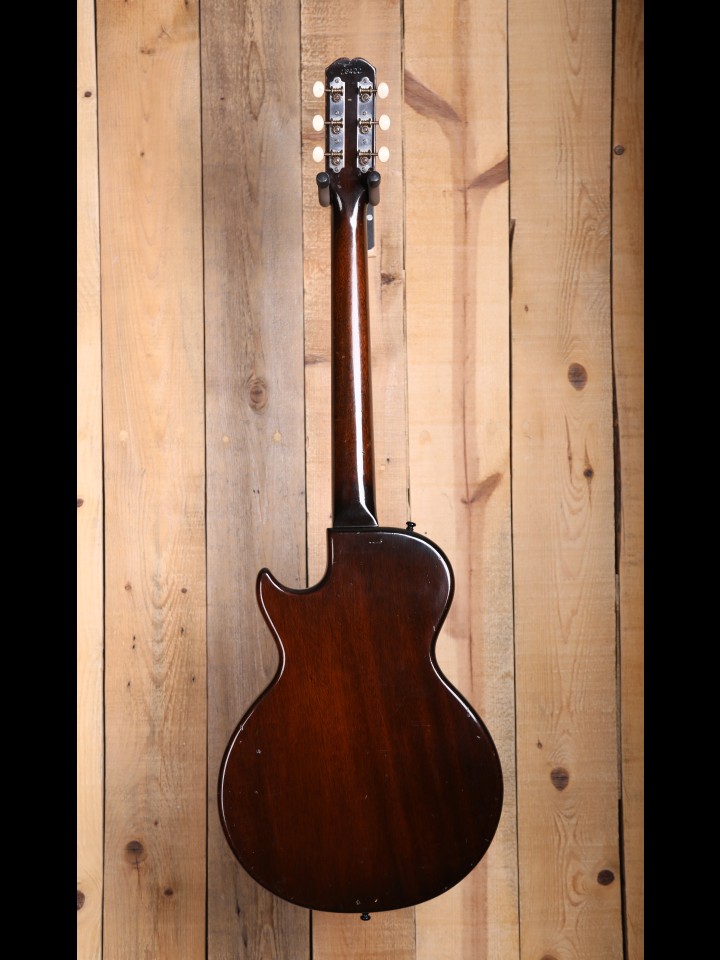
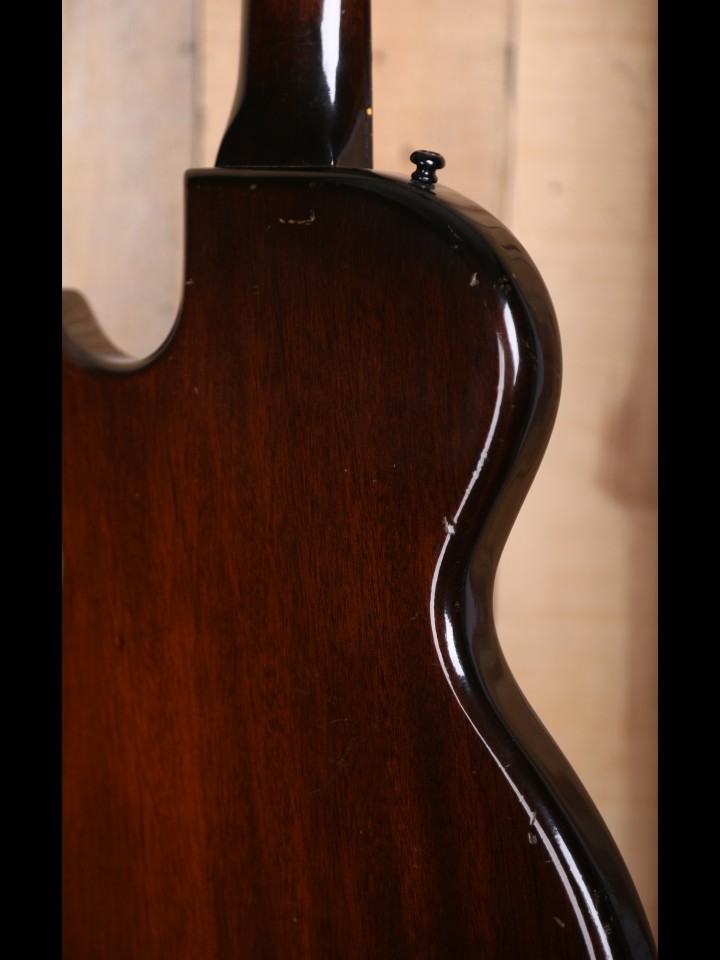
This Epiphone Olympic was part of a late guitarist’s estate, most of which we purchased in the fall of 2025. By all indications, most of the guitars in the estate were stored for many years in fairly humid conditions, as every guitar had some degree of mold, mildew, or oxidation to address. Despite these obvious obstacles, it was clear that there were some real gems to be unearthed and resurrected! After several hours of meticulous cleaning, this Olympic came together very nicely. From a cosmetic standpoint, the guitar has a good amount of honest wear but is fairly clean for its age. The body has numerous dents, dings, as well as a few finish chips that would be consistent with regular use. Of these, the most significant wear is arguably a finish chip that is approximately 5mm in diameter, located approximately 40mm below the bass-side bridge anchor. There is otherwise: a smaller chip below the treble-side anchor, a couple minor chips on the back, and some gouging/scrapes on the side at the treble-side lower bout. We also note a small patch of shallow belt rash on the back towards the bass-side waist. All in all, this amounts to the worn-in patina that we expect (and sometimes desire!) in a bonafide vintage guitar—it was loved and played, not dismissively stored under the bed!
From a playability standpoint, this guitar is very well dialed-in, having been thoroughly prepped in our repair shop. The neck has uniform relief, the truss rod has good movement, and the action is set at our specs—approximately 1/64” - < 1/32” clearance at the nut and 2/32” – 5/64” clearance at the 12th fret (from the high E to low E), with approximately .005” neck relief. In addition to our customary setup work, we leveled and re-crowned all the frets. Following the fret level, the original frets still have very healthy height at .040”.
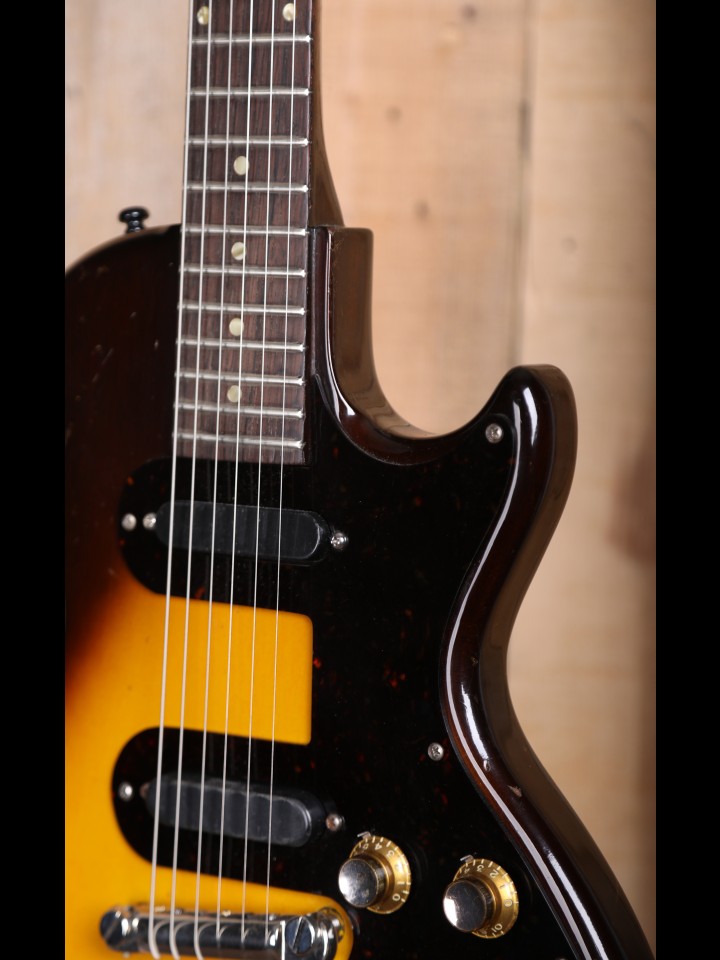
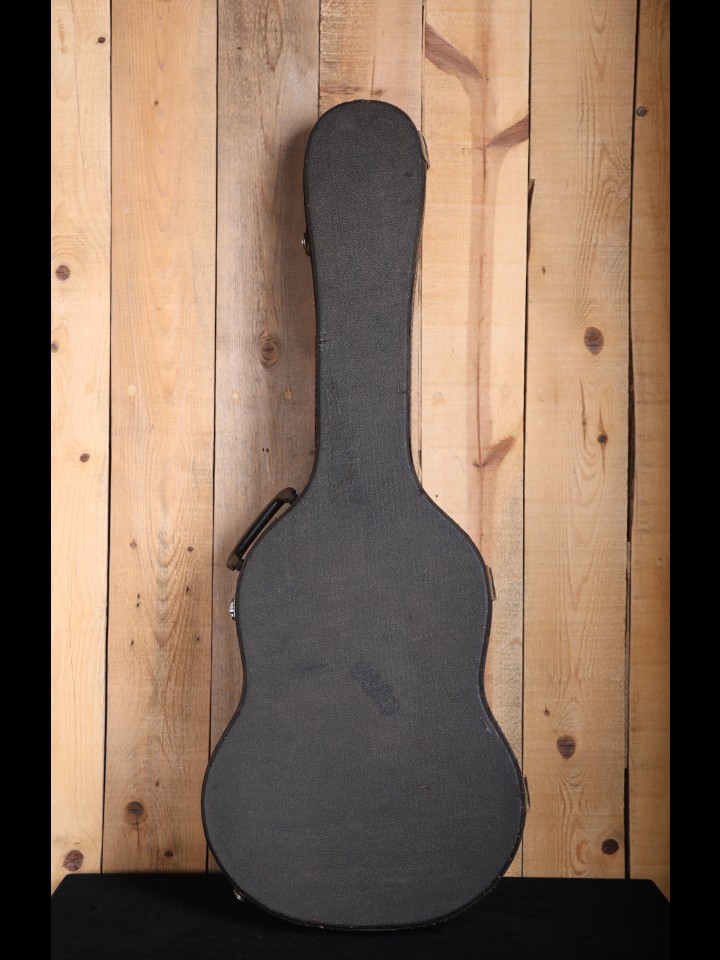
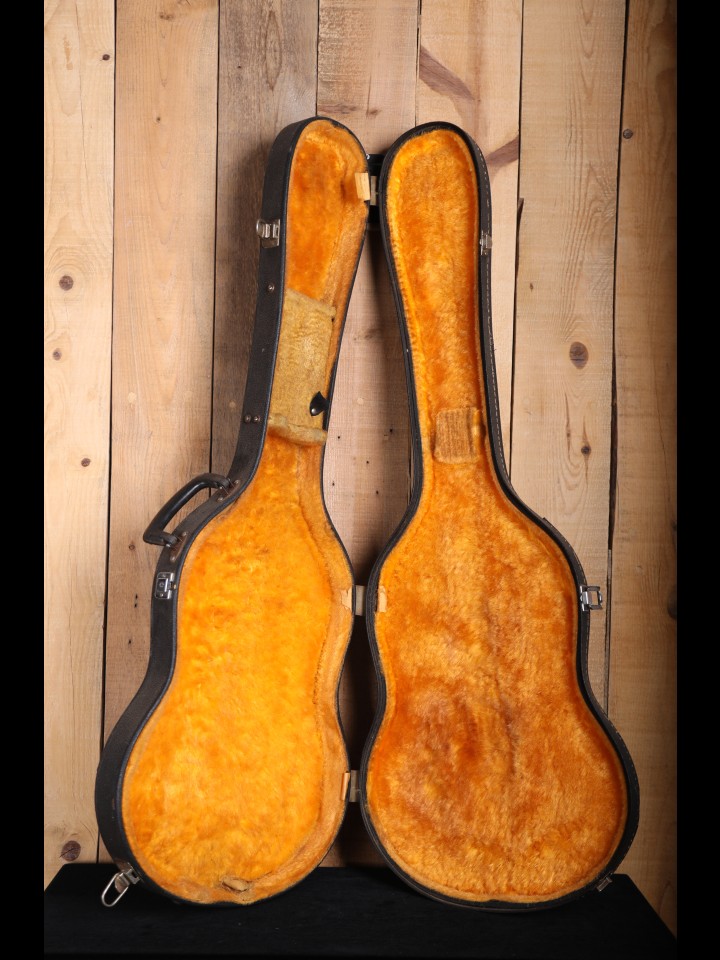
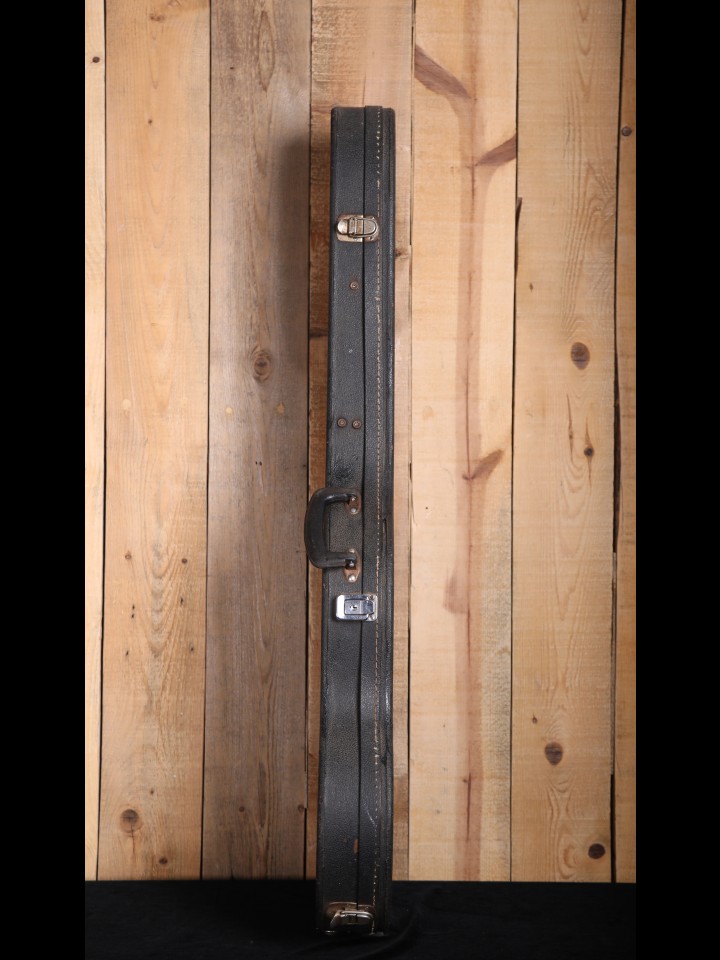
We do note that this guitar has some history of modification both externally and under the hood that would be important for any buyer to understand. In cleaning and restoring the electronics, we quickly observed that, though the neck pickup was original, the bridge pickup had been replaced with a later Fender Telecaster pickup. We have since sourced an original bridge pickup and installed it prior to offering the guitar for sale. Both neck position potentiometers have been changed—the code on one is obscured by solder, but we can tell that the other is a CTS 250K dating to 1997 (13797xx)—but the bridge pots are original CentraLab pots dating to the second week of 1961 (1346102), and the Sprague capacitors appear to be original. Some splicing of the neck pickup leads appears to have occurred at this time, but we have checked these connections and repaired them as needed. The input jack and pickup selector switch (Switchcraft) are also likely non-original parts. Though fairly insignificant, we see that the skirt of the original control knob for the bridge position tone was cracked and super-glued at some point. Rather than replace this part, we have verified that the glue joint is secure, added a tidy span of additional glue on the back of the seam inside the knob, and then cleaned and polished the original glue joint. Otherwise, we note two modifications to the body. The most obvious is three open mounting holes on the top with a corresponding faint U-Shape footprint, presumably from a previous vibrato installation. The other modification is a drilled-out section of the body corresponding to the replaced jack. Fortunately this modification is well hidden beneath the pickguard, but it is there all the same! Finally, the accompanying hard case appears to be a period case (possibly original); but, as mentioned above, it was definitely exposed to humid storage conditions and thus had some mildew and/or mold present when we acquired the guitar. We have taken great pains to sterilize and clean the case exterior and interior, but some traces of musty odor may remain. A replacement case or good quality gig bag is probably advised! – VERY GOOD Condition
- Single Cutaway Solid Body
- Single-Piece Mahogany Body
- Full Gloss Nitrocellulose Lacquer Body Finish (Sunburst Top Only)
- Single-Piece Mahogany Neck
- Slim C-Shape Neck Carve
- Rosewood Fingerboard
- Pearloid Dot Fingerboard Inlays
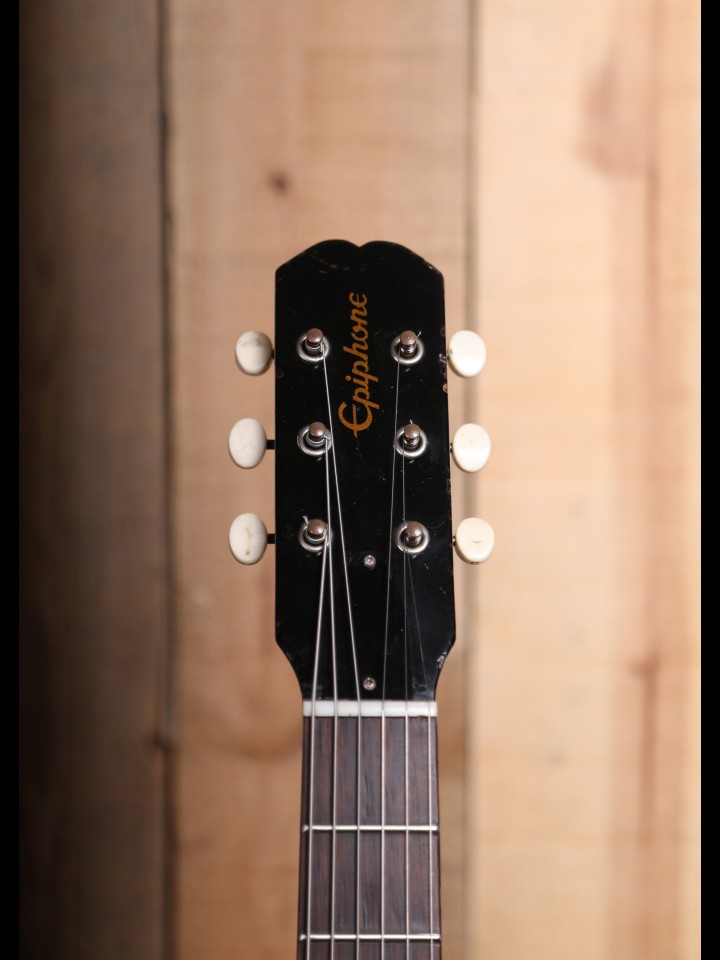
- Black Headstock Face with Gold “Epiphone" Logo
- Black Truss Rod Cover
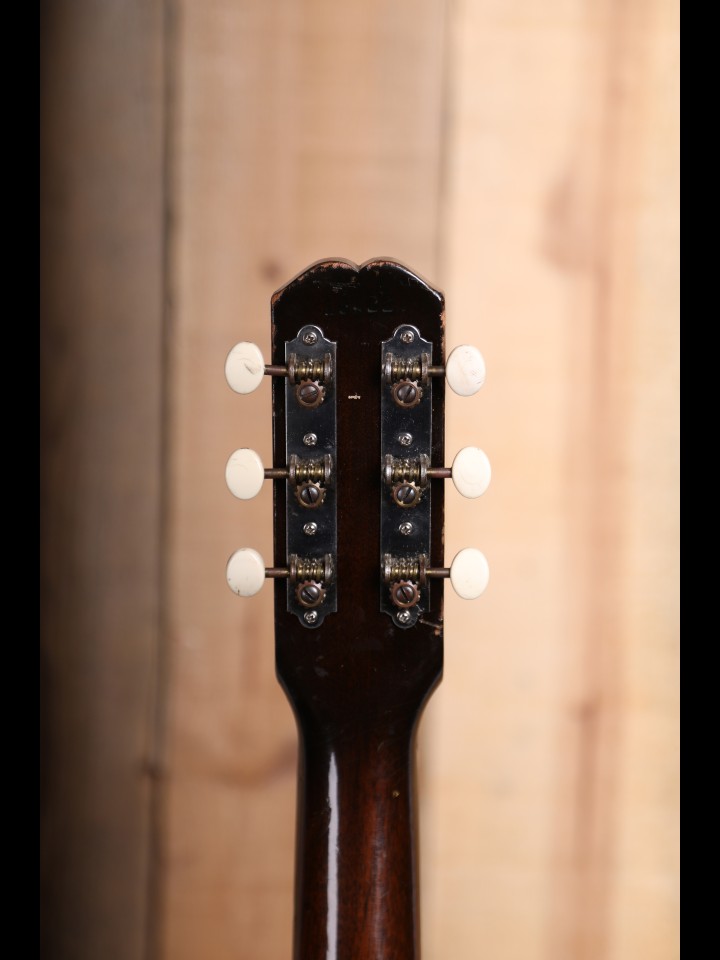
- Nickel 3-On-A-Plate Kluson Tuners with White Oval Buttons
- Two Single-Coil Pickups with Black Covers
- Two Master Volume and Two Master Tone Controls
- Gold Skirted Control Knobs with Foil-Caps
- 3-Way Pickup Selector (Non-Original Switchcraft)
- Nickel Warparound Bridge
- Single-Ply FauxTortoiseshell Pickguard
- 1 11/16th” Nut Width
- 24 ¾” Scale Length
- 5.9 lbs (2.7 Kg)
- Period Hard Case
| Brand | EPIPHONE |
| Model | OLYMPIC SC |
| Serial Number(s) | 19422 |