




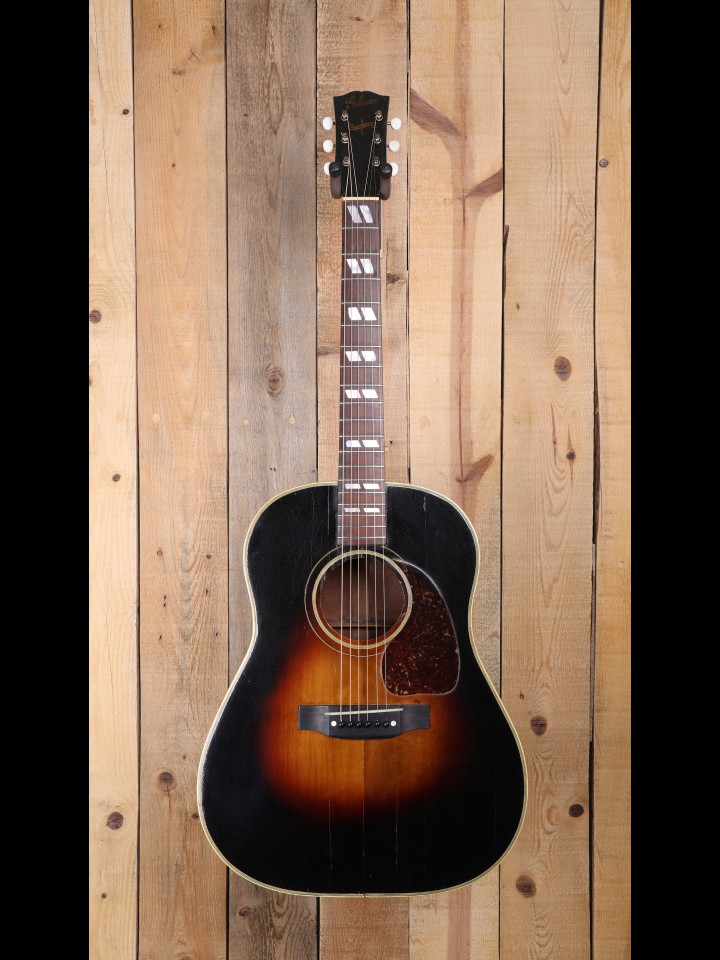

C. 1942 Southern Jumbo
Introduced in late 1942, the Gibson Southern Jumbo was in effect a continuation of the J-55 (1939-1942). By the reckoning of some Gibson historians, the Southern Jumbo was originally designed for Gibson’s southern (i.e., south of the Mason-Dixon line) sales rep. Given that the SJ, like the J-55, is essentially a gussied-up J-45, this seems entirely reasonable, as sales reps and dealers everywhere are always keen to have something distinctive to offer to get an edge on the competition—to quote Mr. Lund, the blind radio DJ in the Cohen Brothers masterpiece, Oh Brother, Where Art Thou?, “Oh mercy, yes! We got to beat that competition!” And, with its multi-ply top border, parallelogram fingerboard inlays, and bottom belly bridge, the SJ evidently made its mark, as it has remained in the Gibson line ever since, despite its similarities to the more humbly-appointed J-45.
Due to the timing of their arrival on the scene, the earliest known Southern Jumbo models were very much a reflection of wartime shortages in terms of appointments. Indeed, as demonstrated by countless extant outliers made during WWII (e.g., the occasional mahogany-topped J-45, random use of maple sides or backs, etc.), Gibson has a well-established reputation for having improvised with whatever parts/material happened to be on hand during this time of material shortage. This is exemplified in one of the earliest documented examples of the SJ, number 8074H-17, which has a 3-piece maple neck, rosewood back and sides, and a pre-war (thus pre-Banner-era) silk screened logo. Quite obviously, SJ number 8074H-17, which was recently sold by RetroFret, in Brooklyn, NY, represents a major departure from what we now think of conventional Southern Jumbo spec. Of course, as many Gibson experts would attest, this production practice of ad hoc improvisation did not end with the war!
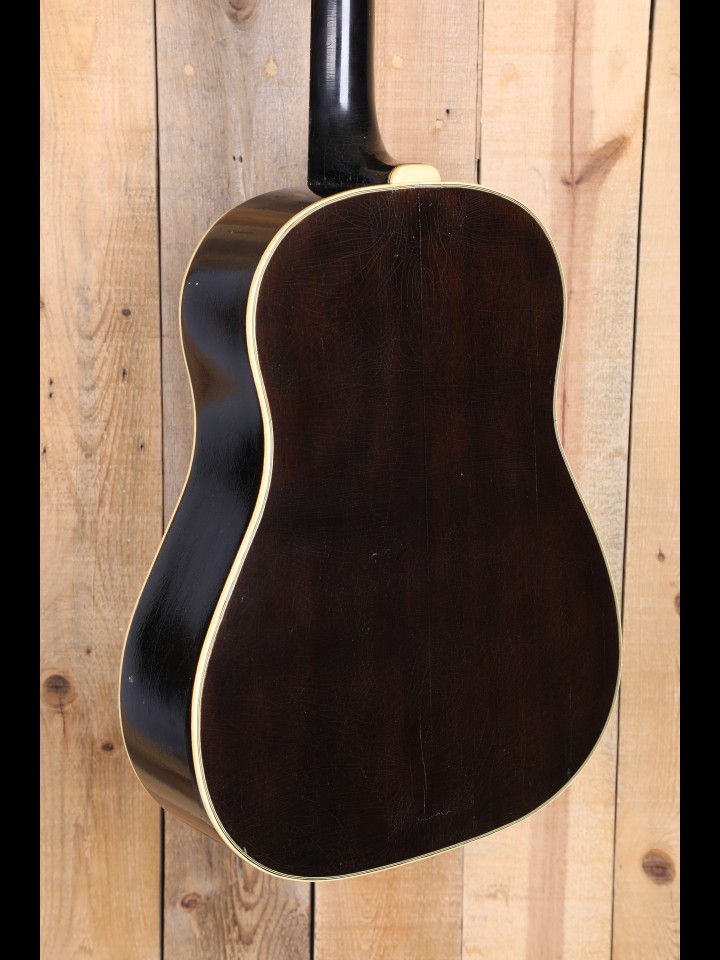
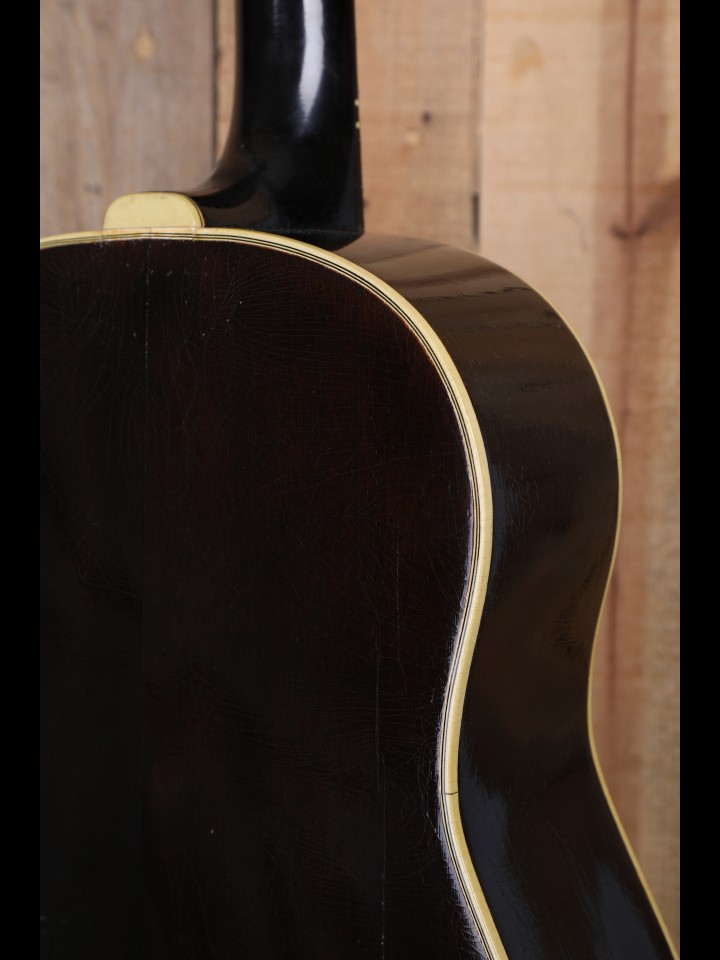
Judging from its features, this Southern Jumbo survivor appears to be a very early example, most likely dating to 1942 or possibly 1943. It is unfortunately the case that its Factory Order Number (FON) has almost entirely faded, such that it remains unreadable, even under UV light, though we can still see the batch number “18” in red pencil. Even so, the presence of a 2-ply white heel cap points to 1942 production, as this feature was supposedly unique to that model year. Yet, as stated above, it is certainly possible that Gibson found a stash of spare necks that were made earlier and used them for a later batch. That said, we also note a mahogany neck block and end block, the former of which once again suggests 1942 production, as Gibson evidently began to use poplar neck blocks extensively (though, once again, not exclusively!) as an alternative to mahogany in 1943. The tortoiseshell pickguard on this SJ remains a bit of a head-scratcher, as it supposedly began to appear in 1943; but, the very well documented early ’42 SJ number 8074H-17A mentioned above also has a tortoiseshell pickguard instead of Firestripe, so go figure! As is typical of early wartime guitars produced during a period of protracted metal rationing, this SJ has a maple neck reinforcement in lieu of a truss rod, as evidenced by triangular outline at the headstock—this feature was also visibly confirmed in the course of the guitar’s neck reset. As truss rods were reintroduced in this model in 1944, this feature would once again suggest that this SJ was made some time in 1942, or possibly early 1943. Incidentally, though adjustable necks are generally preferred, wooden reinforcement in conjunction with the beefier C carve, like that seen on this SJ, have historically proved to be very, very effective in terms of preserving neck conformity/straightness. Moreover, they also reduce neck weight!
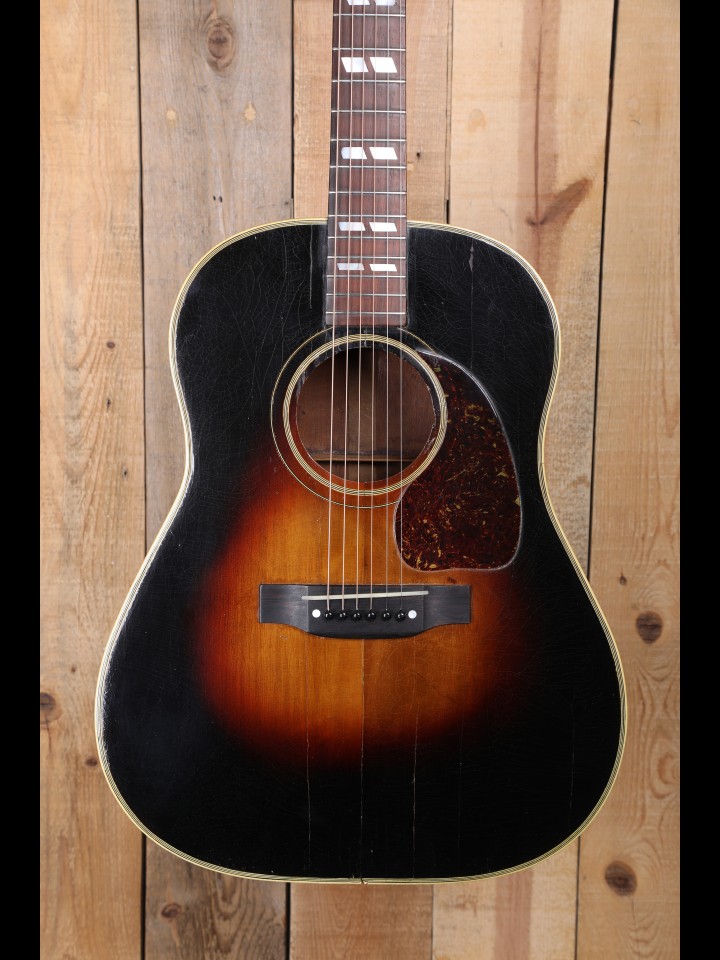
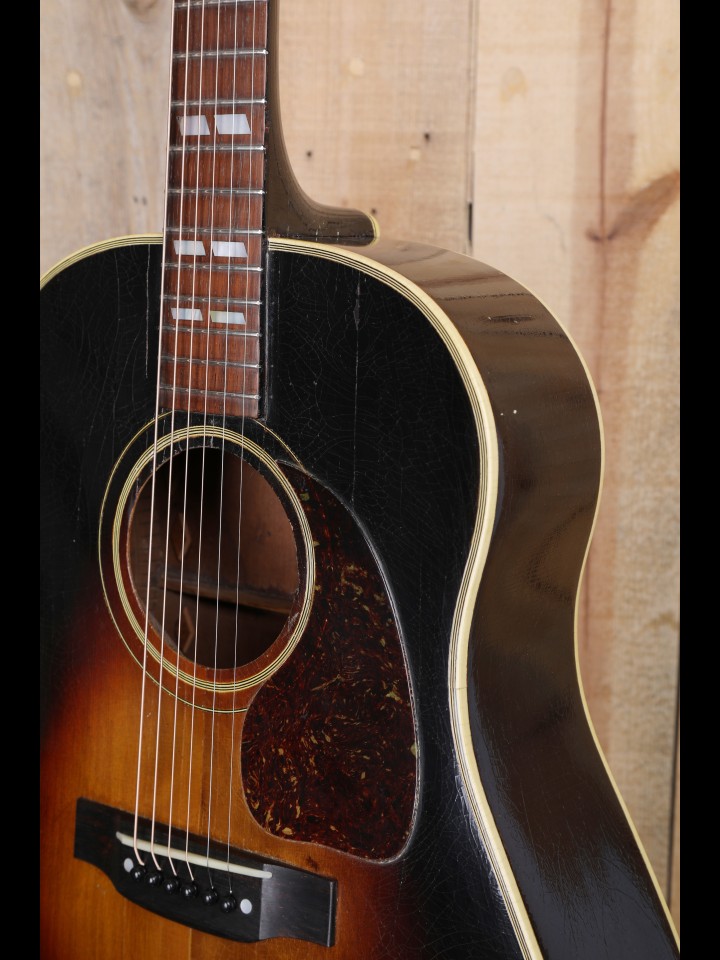
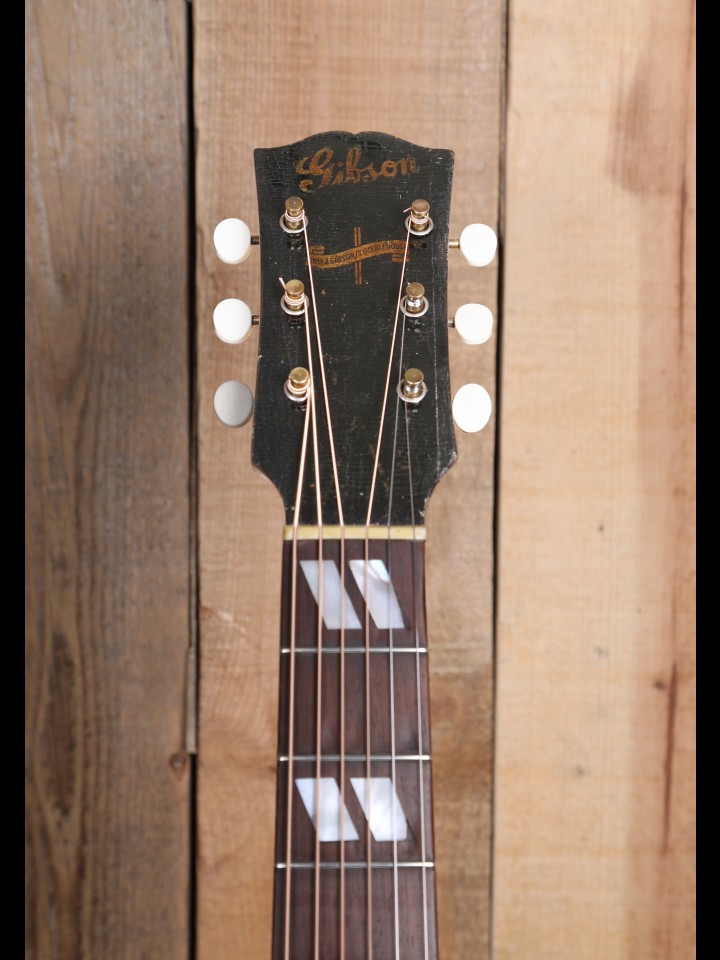
As mentioned above, this fine old Southern Jumbo is a survivor with a lot of wear and tear, but it is a truly special guitar. It was perhaps the crown jewel of a fair-sized estate of approximately forty dusty, musty, moldy guitars that we recently purchased. In fact, this SJ was one of the first guitars viewed in the initial evaluation of the lot; and, upon seeing it, we resolved to purchase the whole collection, if necessary, for this one guitar—and we did! Like most of the guitars in the collection, this SJ had clearly been stored in poor conditions for some indeterminate amount of time. Furthermore, it had obvious signs of what proved to be somewhat crude repairs. Without having the former owner around to shed light on the guitar’s history, one can only guess at who had done the existing repair work, or when and why it had been done. Perhaps most obvious was the fact that the entire instrument has some degree of overspray, as evidenced by the somewhat unnatural sheen of the finish, particularly on the headstock, where some of the logo and banner seem to have blurred or smeared, perhaps in reaction to the overspray. There were numerous extensive top cracks as well as some body cracks evident, some of which had been addressed and some of which had not. Upon further inspection, those that had been addressed were cleated in a rather heavy-handed, albeit effective, manner, as very large, thick, and inconsistently shaped cleats were added. Unfortunately these jumbo cleats were firmly in place, so we elected to leave them alone rather than replace them, out of concern for the top. Finally, there was a fair amount of top belly; and, coinciding with this, the original bridge had clearly been roughly removed, relocated, and then shaved down to the point of being unsalvageable. Incidentally, in evaluating the top, we discovered an old label with the name and address of some previous owner named Claude, from Van Buren, Arkansas—perhaps this SJ’s name should be Claude, but the guitar has yet to confirm this with us.
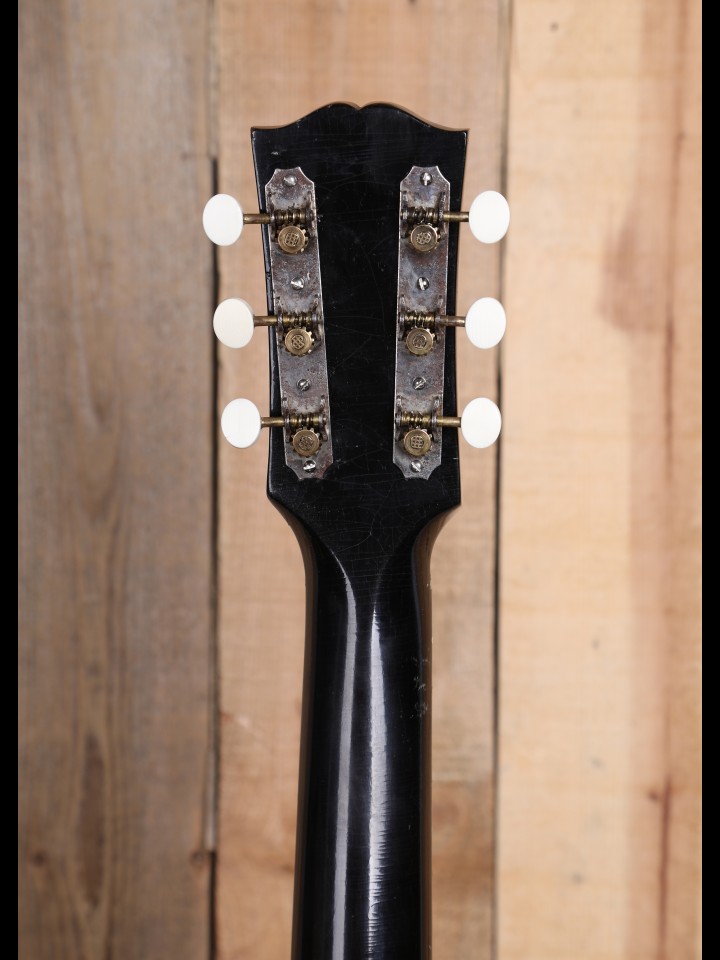
As terrifying as all these ailments may sound, this SJ was certainly not DOA! Truth be told, it is just not that uncommon for guitars of this era to exhibit such structural wear (if not worse), especially if they were actively used. So, we entrusted the guitar to one of our local luthier friends, Jeff Henry, who is well-qualified to resuscitate such poor old six-strings. In the course of the project, the guitar underwent the following surgeries: a neck reset with a concomitant re-fret; a top belly reduction (a la TJ Thompson); a new slightly oversized bridge installation (to better stabilize and mask some top wear from the previous bridge removal); a Bridge Saver bridgeplate repair; various crack repairs; and tuning machine restoration (the original tuners were very functional, but needed cleaning and new buttons—this was done here, at Maple Street Guitars). Like many old things that have grown accustomed to their ways after being previously pestered, this SJ evidently proved to be quite ornery during its time on the repair bench and offered resistance at every opportunity—Jeff later described it as being “a grumpy old man, who didn’t want to be touched.” Yet, Jeff persevered and prevailed, and this tremendous SJ is now back in action!
In playing this newly-resurrected Southern Jumbo, one is instantly presented with the classic sloped shoulder jumbo voice. When picked, the notes are dry, crisp, and well-separated; yet, when strummed or abruptly “chunked” in a rhythm application, a depth in the low end emerges that produces that distinctive “thump” found only in great old Gibsons. While this SJ already demonstrates a commanding presence and powerful projection, one gets the sense that the old man is still being roused after being relegated to a life in cold storage for so many years, as one can readily detect the guitar opening up as it is played. Thus, the story of this SJ mirrors that of the archetypical grumpy-old-man-character in a movie, where the interaction with a new and unlikely friend reveals that the grumpy old man was never really that grumpy after all. Instead, a kindness and wisdom is unearthed that has simply lain dormant while loneliness took hold and the world marched on. With new perspective and new friends, opportunity blossoms for the old man, and the story ends with happiness and hope on the horizon.
Condition
As stated above, this SJ had numerous cracks that have since been addressed. Most obvious are those extending from the bridge to the butt on the top. Though it has been stabilized, one of these cracks was broad enough that it didn’t fully close, and thus remains open. Though properly shaped as a bottom belly style, the bridge is a slightly oversized Brazilian rosewood replacement (the original bridge was unsalvageable). The neck has been reset, and the frets have been replaced. The guitar also has evidence of complete overspray. GOOD+ Condition
- 16” Slope Shoulder Body
- Adirondack Spruce Top
- Scalloped X-Bracing with Two Scalloped Tone Bars
- Mahogany Back and Sides
- Sunburst Finish
- White Top and Back Binding
- 6-Ply Black/White Top Purfling
- 4-Ply Black/White Back Purfling
- Mahogany Neck
- Deep C Neck Contour
- Mahogany Neck Block with Mahogany Endblock
- Brazilian Rosewood Fingerboard
- Mother of Pearl Parallelogram Fingerboard Inlays
- Solid Headstock with Scalloped Sides
- Gold Silkscreened Logo with “Only a Gibson is Good Enough” Banner
- Oversized Brazilian Rosewood Belly Bridge with Mother of Pearl Dots
- Open Gear Kluson Tuners with White Oval Buttons
- Bone Nut
- Bone Through Saddle
- Teardrop Tortoiseshell Pickguard
- 1 3/4” Nut Width
- 24.9” Scale Length
- 1.06” Neck depth at 1st fret
- 1.10” Neck depth at 12th fret
- 2 3/16” String Spacing at the Bridge
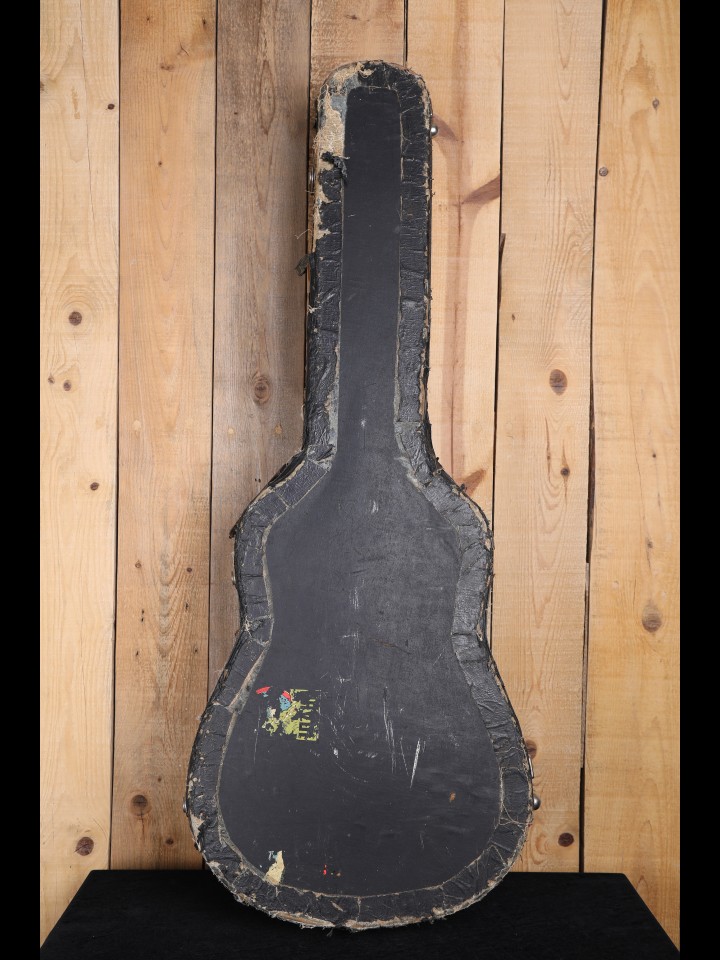
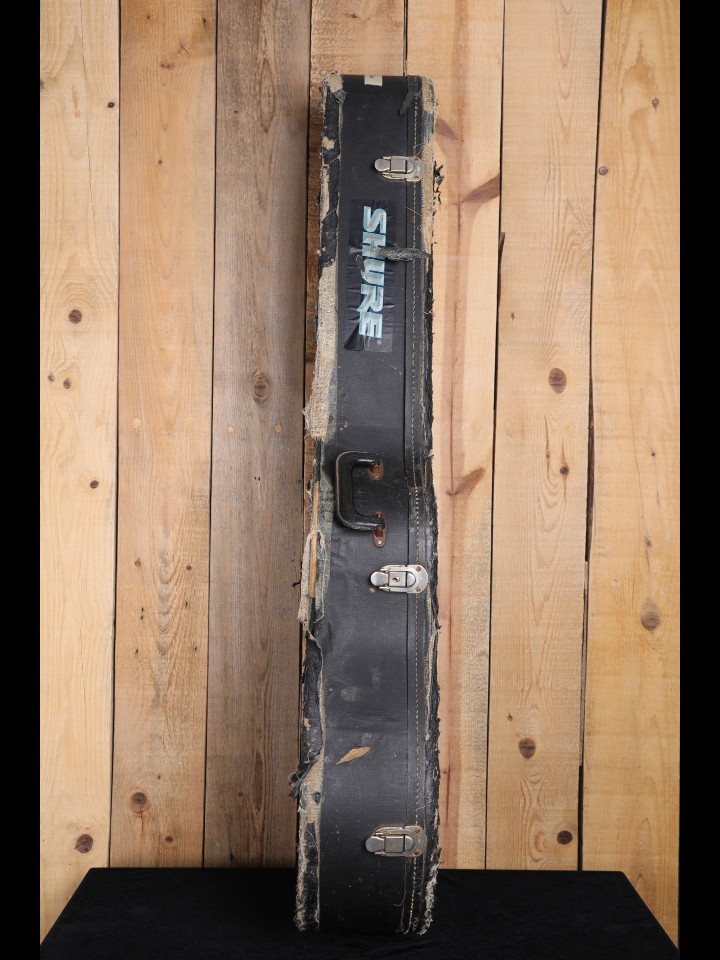
- Non Original Hard Case (Poor Condition)
| Brand | GIBSON |
| Model | C. 1942-43 SJ |
| Serial Number(s) | FON XXX 18 |